

When California Highway Patrol officers in riot gear dispersed pro-Palestininan protests at UCLA earlier this month, it marked the first public test of a 2021 California law restricting the use of less-lethal munitions against protesters.
Yet a review by CalMatters investigative reporter Sergio Olmos, who was recording video from inside the encampment, documented at least 25 instances in which officers appeared to aim their weapons at the eye-level of protesters or fired them into crowds that didn’t appear to present an immediate threat to life or serious injury.
State training guidelines say these types of munitions “shall not be aimed at the head, neck or any other vital organs.”
- Travis Norton, a retired police lieutenant who developed a course on the use of less-lethal weapons for the California Commission on Peace of Officers and Standards Training: “We do not train to point at people’s heads unless it’s a deadly force situation.”
The weapons could accidentally discharge and seriously harm protesters. The manufacturer of beanbag rounds, Combined Tactical Systems, warns that, “Shots to the head, neck, thorax, heart, or spine can result in death or serious injury.”
The 2021 law has an exception: Officers can use the munitions when there is a “threat to life or serious bodily injury.”
- CHP, in a statement: “When certain demonstrators in the unlawful assembly created an immediate threat to officers — including through the launching of objects and weapons — sponge rounds and bean bag rounds were used on a limited basis in response.”
Protesters do not appear to attack or threaten the CHP officers in the videos recorded by CalMatters, including the same videos in which police are seen aiming or firing less lethal munitions. No felony battery or assault charges have been announced against protesters.
Under the law, CHP will have to post a report on the use of impact munitions online within 90 days.
Read more on what Sergio witnessed in the story.
California teachers: Want to launch a news program at school? New to teaching journalism? CalMatters’ Journalism Educator Fellows receive mentorship, curriculum support, stipends and more. Apply by May 31 here.
Other Stories You Should Know
Dangerous commute for CA farmworkers

California may be best known for Hollywood and Silicon Valley. But agriculture is a big part of the state’s economy — $59 billion a year in products — and deeply woven into its landscape.
And the welfare of the state’s 800,000 full-time and seasonal farmworkers is a constant push and pull, complicated by the fact that many are undocumented. Though a controversial law has made it easier for farmworkers to unionize, an understaffed Cal/OSHA still struggles to protect farmworkers. Meanwhile, workers are slow to see stronger outdoor heat protections, safer work environments and better housing.
CalMatters Capitol reporter Jeanne Kuang, with assistance from data reporter Jeremia Kimelman, spent 10 weeks, off and on, taking a deep look into one key aspect: How farmworkers get to and from the fields — often the most dangerous part of the job.
Some of their major findings:
- Unregulated, smaller vans carrying eight or fewer farmworkers have become more common for commutes, but are deadlier: 54 have been killed since 2012 in uncertified vans, while only 1 has died in a state-certified vehicle since 2000.
- Between 2015 and 2022, 58% of agricultural workers who died on the job in California were killed in transportation incidents, compared with 47% nationwide.
- The Highway Patrol’s farm vehicle safety unit certifies less than 10% of the vehicles it did when safety laws took effect in 1999.
Part of the reason why officers are inspecting fewer cars is because they don’t know who is responsible for providing safe vehicles. The laws don’t regulate these smaller, uncertified vans and many employers no longer provide transportation.
- Manuel Cunha Jr., Nisei Farmers League spokesperson: “The transportation of farmworkers today by employers is just about nil, because the regulations — not the safety side, but what you have to go through, and what agencies you have to deal with — it’s not easy.”
But farmworker advocates, such as the United Farm Workers union, argue that employers should be held accountable. (Last month, the organization successfully pushed the federal labor department to require vehicles in guest worker programs to have seat belts).
- Elizabeth Strater, union spokesperson: “There are workers who are so economically desperate that they’re not going to turn down the transportation options they have.”
For more on this issue, read Jeanne and Jeremia’s story.
When will Newsom deliver State of State?
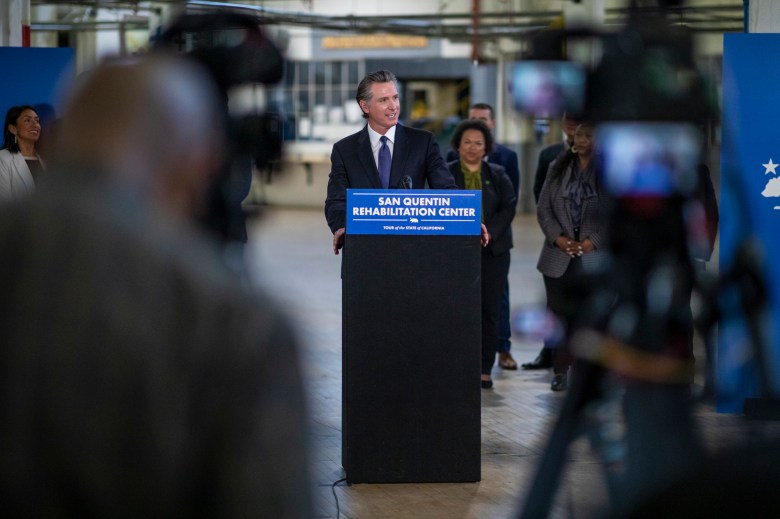
The state constitution requires California’s governor to report to the Legislature on the “state of the state.”
Governors have used the annual speech to announce big programs and set the agenda before proposing a budget in early January. But the “State of the State” has largely lost its luster since its heyday under Gov. Pat Brown in the 1960s.
Gov. Gavin Newsom has continued upending that tradition, since his first one in 2020 when he focused entirely on homelessness.
In March 2021, he delivered the speech in an empty Dodger Stadium to symbolize the loss of the COVID-19 pandemic. In March 2022, Newsom gave a pep talk, months after overcoming an attempt to recall him from office. In March 2023, he went on a high-profile policy tour and sent a letter to the Legislature instead of making a speech.
And this year? It’s May, and Newsom still hasn’t scheduled the address. Asked what was taking so long at his Friday budget presentation, he said he’s still coordinating the timing with legislative leaders. But mostly he was dismissive, laughing at the question.
- Newsom: “I feel like we’ve just finished it today, as we’re going off topics… .We’re running around with certain dates. So I’m glad you care. You’re the first person.”
The speech definitely won’t be this week: Newsom is headed to the Vatican to meet Pope Francis and talk about climate action.
Republicans, meanwhile, aren’t letting Newsom forget his tardiness, posting a calendar on social media at 50-plus days and counting.
California Voices
CalMatters columnist Dan Walters: After devoting much attention and money to expand health care coverage, add prekindergarten and aid the poor, advocates say Gov. Newsom’s latest budget proposal would punish the same recipients.
Ideas festival: CalMatters is hosting its first one, in Sacramento on June 5-6. The full agenda is now available. It will include a broadband summit; sessions on artificial intelligence, climate, elections, homelessness and workforce development; and an exclusive IMAX screening of “Cities of the Future.” Find out more from our engagement team and buy tickets here.
Other things worth your time:
Biden, Trump head to SoCal for big fundraisers // Los Angeles Times
Major agricultural firm sues CA over farmworker union law // AP News
CA local health officials warn against cutting funding // CapRadio
What’s the success rate of CA Latino caucus bills? // The Sacramento Bee
US Supreme Court rejects CA immunity in prison COVID deaths // Los Angeles Times
As OpenAI unveils big update, protesters call for pause in ‘frontier’ tech // KQED
CA program tests getting EV drivers to pay for road repairs // LAist
Alameda officials stop first-of-kind geoengineering experiment // San Francisco Chronicle
Raw milk enthusiasts uncowed by bird flu risk in dairy // Los Angeles Times
Has SF dodged the worst-case ‘doom loop’? // San Francisco Chronicle
Screenwriters struggle to find work amid Hollywood woes // Los Angeles Times