Braceros, or Mexican farm workers, are shown in this undated photo in California. From 1942 until 1964, about 4.5 million Mexicans were brought in to temporarily work in U.S. farm fields. The braceros, now in their 70s, 80s and 90s, are still fighting to recover the the money that was deducted from their wages and promised by Mexico's government.
Oscar Serna is still waiting for wages he is owed from working in the farm fields of California and Texas more than 70 years ago.
Serna was 16 when he came from Mexico and was hired under an agreement between the U.S. and Mexico governments to work in the fields, where he picked oranges and grapefruit. Now 90, he already has started to forget things, but he remembers this: The governments put 10% of their paychecks in “savings funds” without the workers’ knowledge.
Serna and about 36,000 other elderly migrant laborers are still waiting to be reimbursed by Mexico, even though a court settlement was approved 21 years ago.
Sick with prostate disease, Serna knows he doesn’t have much time to keep fighting for his lost wages.
“Our money was stolen, what are we going to do?” he said. “They haven’t given me anything. They owe me my money.”
Serna was part of the Mexican Agricultural Labor Agreement, known as the Bracero Program. While American soldiers fought in World War II, about 4.5 million Mexicans were brought in to temporarily work in U.S. farm fields and railroads. The bilateral guest worker agreement between Mexico and the United States lasted from 1942 to 1964.
At least $32 million was deducted from the workers’ wages and put into Mexican savings accounts under the labor agreement. The promise was that the workers would receive their money once they returned to Mexico. Many of the workers couldn’t read and were unaware of the deductions.
“The deal between the two governments was that they were going to discount the tithe as an incentive for them to return to Mexico at the end of the contract and the Mexican government would disburse them the withheld money,” said Professor Gaspar Rivera, Director of Academic Projects at UCLA’s Center for Labor Research and Education.
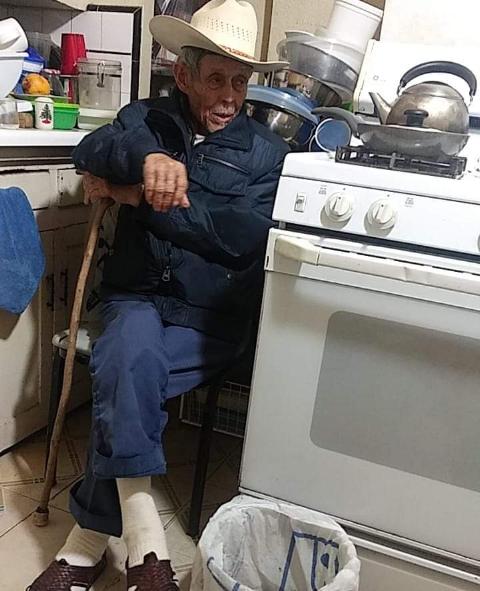
Oscar Serna, 90, is still waiting for the earnings that were taken from him when he worked in California fields in the 1940s. Photo by Jorge Macías
“Now, many elderly men are still waiting for their reimbursement, he said. “That illustrates the tragedy of the braceros who were part of an exploitative program.”
All of the braceros are now in their 70s, 80s and 90s, and many are sick like Serna, who is torn between life, poverty and ignominy of the country where he was born.
Sitting in a plastic chair in the front yard of his son José’s house in San Bernardino and leaning on a mesquite cane, Serna said he suffers from prostate problems and has a catheter and bag for emptying his bladder, but cannot afford doctors. Born in Huatusco, Zacatecas, he is still undocumented; he never wanted to apply for US residency.
“The first time I came to the United States, I crossed the Rio Bravo a la brava [illegally],” he said. “Then I was hired to work at the field.”
The bracero program guaranteed workers a minimum wage of 50 cents per hour, insurance and safe, free housing. However, farm owners frequently failed to live up to these requirements. Housing and food routinely was well below standards, and wages were not only low, but also frequently paid late or not at all.
In 2001, the braceros filed a class action lawsuit in the Federal District Court in San Francisco against the governments of the United States and Mexico, along with Wells Fargo Bank, where the money deducted from their paychecks was deposited and then transferred to the National Rural Credit Bank of Mexico. The U.S. government and the bank were later dismissed as defendants.
In 2008, the Mexican government agreed to pay $14.6 million to the braceros who worked during World War II and live in the United States. Each one was awarded 38,000 pesos, which currently is about $2,000 U.S.
“It was a very difficult lawsuit to litigate,” recalled Jonathan Rothstein, a Chicago lawyer who represented the braceros. “It is a tragedy that all the workers have not gotten paid yet, but sometimes the fight for justice is a long battle. Sometimes you take steps forward and sometimes you go backwards.”
About 36,000 ex-braceros still have not received the money, a third of them living in California, said Baldomero Capiz, coordinator of the Binational Union of Ex-braceros.
“We have been struggling for the past 20 years to recover the savings fund for farmers,” Capiz said.
The money was included in the Social Support Trust established by former Mexico President Vicente Fox. It was continued by his successor, Felipe Calderón, but President Enrique Peña Nieto, who served from 2012 to 2018, did not assign money to comply.
Mexico is still debating whether to recognize the “historical debt,” as it is called. The current administration of President Andrés Manuel López Obrador would have to recognize the debt in order to return the rest of the money to the braceros.
“What they have done with the seniors is a violation of their human and constitutional rights as Mexicans residing in the United States,” said Rosa Martha Zárate, leader of the Ex Braceros del Norte Alliance.
“When we requested that social support of 38,000 pesos, we had to take the old men to Mexicali to notarize their letters, obtain more documents, apostilles and a whole tangle of procedures.”
“Our money was stolen, what are we going to do?” Oscar Serna said. Photo by Jorge Macías
Edna Silva, a spokesperson for Wells Fargo, said that the bank sent wages for the Bracero Program to Mexico totaling $34.7 million, an amount based on reports from the Mexican government.
Silva said that under diplomatic agreements between the U.S. and Mexican governments, it was the Bank of Mexico’s responsibility to distribute the funds to local Mexican banks for the braceros, with Wells Fargo having no role in the savings fund reconcilement process in Mexico.
At the end of October, Oscar Rafael Novella Macías, Mexican secretary of the Committee on Migration Affairs in the House of Representatives, said in an open parliament session that the government should waste no more time because the braceros “are sick, old and in poor health and we have to make political-legislative efforts.”
Mexican representative Julieta Kristal Vences Valencia, president of the committee, requested 500 million pesos ($26.3 million US) in the 2019-2020 budget to make the payments. Vences Valencia did not respond to numerous requests for an interview with La Opinion.
But the promises made by politicians do not convince ex-bracero Nicolás Martínez, a Nahuatl indigenous from Coyotepec, Puebla, who lives in Los Angeles.
“Let me get back what they took away from me,” said Martínez.
Now 90, his wrinkles and calloused hands reflect the hardness of having worked in the fields of California and Arizona picking tomatoes and cotton between 1942 and 1947.
“Government has always ignored us and kept us in poverty on purpose,” he said.
Leobardo Villa, on the right, is tired of fighting for the bracero money. “Like all my coworkers, we left our skin in the furrows and railroad tracks,” he said. “We are not asking the government for a gift but for what belongs to us.”
At his home in Lincoln Heights, another ex-bracero, Leobardo Villa, a native of Zacapala, Puebla, said that at his age, he is tired of so many protests. He is 87.
“I came to work in the fields of California and Yuma, Arizona, at the age of 18 to sow watermelon, cantaloupe, all kinds of vegetables,” he said. “Like all my coworkers, we left our skin in the furrows and railroad tracks.
“We are not asking the government for a gift,” he said, “but for what belongs to us.”
Jorge Macías is a freelancer at La Opinión, the only Spanish newspaper printed in Los Angeles. This article is part of The California Divide project, a collaboration among newsrooms examining income inequality and economic survival in California.
Republish
Time is running out for the braceros
We love that you want to share our stories with your readers. Hundreds of publications republish our work on a regular basis.
All of the articles at CalMatters are available to republish for free, under the following conditions:
Give prominent credit to our journalists: Credit our authors at the top of the article and any other byline areas of your publication. In the byline, we prefer “By Author Name, CalMatters.” If you’re republishing guest commentary (example) from CalMatters, in the byline, use “By Author Name, Special for CalMatters.”
Credit CalMatters at the top of the story: At the top of the story’s text, include this copy: “This story was originally published by CalMatters. Sign up for their newsletters.” If you are republishing commentary, include this copy instead: “This commentary was originally published by CalMatters. Sign up for their newsletters.” If you’re republishing in print, omit the second sentence on newsletter signups.
Do not edit the article, including the headline,except to reflect relative changes in time, location and editorial style. For example, “yesterday” can be changed to “last week,” and “Alameda County” to “Alameda County, California” or “here.”
If you add reporting that would help localize the article, include this copy in your story: “Additional reporting by [Your Publication]” and let us know at republish@calmatters.org.
If you wish to translate the article, please contact us for approval at republish@calmatters.org.
Photos and illustrations by CalMatters staff or shown as “for CalMatters” may only be republished alongside the stories in which they originally appeared. For any other uses, please contact us for approval at visuals@calmatters.org.
Photos and illustrations from wire services like the Associated Press, Reuters, iStock are not free to republish.
Do not sell our stories, and do not sell ads specifically against our stories. Feel free, however, to publish it on a page surrounded by ads you’ve already sold.
Sharing a CalMatters story on social media? Please mention @CalMatters. We’re on X, Facebook, Instagram, TikTok and BlueSky.
If you’d like to regularly republish our stories, we have some other options available. Contact us at republish@calmatters.org if you’re interested.
Have other questions or special requests? Or do you have a great story to share about the impact of one of our stories on your audience? We’d love to hear from you. Contact us at republish@calmatters.org.
Gift this article
Comment
Time is running out for the braceros - CalMatters
About 36,000 immigrant farm workers have not received the money they were promised. They are old and sick, with many living in poverty.