
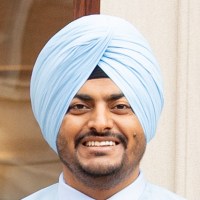
Diesel engines once roared to life each morning at Bikramjeet Singh Gill’s truck depot in Stockton as drivers conducted their pre-trip inspections before heading out to destinations across the United States. Now, dozens of his trucks stand idle, accumulating dust and debt.
Around 35 of Gill’s immigrant drivers were notified since last fall that the Department of Motor Vehicles was canceling their commercial driver’s licenses. And, they were gone.
“We have lost nearly $2 million in the last four months while paying $200,000 monthly to the bank and insurers for 35 parked trucks. The banks don’t wait,” Gill said, who runs Gillson Trucking Inc.
His employees and his trucks are tied up in one of the flash points of the Trump administration’s broad crackdown on all kinds of immigration.
The company’s travails began in September when the Trump administration released an audit that questioned the legitimacy of about 17,000 California commercial drivers licenses held by immigrants, finding licenses with expiration dates that exceeded the drivers’ authorization to live and work in the U.S.
California followed up by notifying those drivers that their licenses would be canceled. The Trump administration also published new regulations in September targeting immigrant drivers, which will ultimately rescind licenses from as many as 61,000 truck drivers in the coming years.
A spokesperson for the Department of Motor Vehicles said the state is ready to begin issuing “corrected licenses to eligible non-domicile drivers,” but the Trump administration has not cleared the state to take that step.
“We are hopeful the federal government will do the right thing and allow California to reissue these commercial driver’s licenses promptly,” said Jonathan Groveman, the DMV spokesperson.
It’s an acute issue for California’s Sikh community. About 35% of the state’s commercial drivers are believed to be Sikh — members of a religious minority who hail from India — according to an industry advocacy group that represents them. They’re well established in California’s Central Valley, the agricultural region stretching from Redding to Bakersfield.


Many Sikh Californians went into debt to immigrate to the United States and truck driving became a vital source of income for them.
The Sikh Coalition, an American Sikh advocacy group, filed a lawsuit with Asian Law Caucus in Alameda Superior Court challenging California’s decision to cancel non-domicile commercial driving licenses.
The Sikh coalition frames this as a civil rights issue targeting “specific groups of immigrant truck drivers.”
“When someone loses their CDL, they lose their livelihood,” said Munmeeth Kaur, the Sikh Coalition’s legal director. “Here, the DMV is intending to cancel the livelihoods of 20,000 people en masse without providing them with any opportunity to be heard, to challenge the decision, and/or to provide evidence on how DMV can correct the error and reissue their license. This is an egregious due process violation.”
The Trump administration’s focus on immigrant drivers intensified after two fatal crashes involving Sikh truck drivers caught national attention. In August, a Sikh trucker, Harjinder Singh, made an illegal U-turn on a highway, killing three people in Florida.
In Ontario east of Los Angeles another Sikh driver, Jashanpreet Singh, 21, of Yuba City, crashed into vehicles stopped on Interstate 10 and killed three people on Oct. 21.

The Trump administration is threatening to withhold transportation funding from the state over what the administration describes as a delay in the license cancellations.
“It’s a day for Gavin Newsom and California. Our demands were simple: follow the rules, revoke the unlawfully-issued licenses to dangerous foreign drivers, and fix the system so this never happens again,” said U.S. Transportation Secretary Sean P. Duffy earlier this month.
Now, thousands of drivers are struggling to make ends meet.
“Every other driver holding a non-domiciled license now can’t secure work. Many companies won’t hire them, and brokers and shippers won’t load trucks with the non-domiciles license holders,” said Raman Dhillon, chief executive officer of North America Punjabi Trucking Association.
‘Totally devastated’
On a recent Friday afternoon, Gill sat in his office wearing his green turban and jacket, answering phone calls, and juggling emails. Certificates of excellence hung on his office walls — proof of his hard work. He and Harsimran Singh worked 18-hours days to build the company and achieve their immigrant dream after leaving Punjab, a state in north India.
Gill started his company with a single truck in 2010. Now he and Singh own nearly 200. Like many trucking companies in California, Gillson relied on a workforce that included immigrant drivers who had legally issued commercial drivers licenses.

Gill contends companies hired immigrant drivers according to guidelines from the state. “Acording to the law, if someone has work authorization and valid licenses then we can hire him. We can’t discriminate against anyone,” he said.
In October, just after the DMV cancelled thousands of commercial licenses, nearly 100 trucks sat parked in his lot.
It “totally devastated us,” he said. “Slowly, some drivers returned to work because they also have mortgages and financial obligations. We have hired green card or U.S. citizen drivers.”
Gill shared that immigrant drivers have become fearful about traveling out of state after Immigration and Customs Enforcement arrested dozens of truckers at inspection and truck stops.
“Our driver was recently arrested by ICE while standing at a truck stop in Minnesota”, Gill said. The man is still in detention, Gill said.
Tejinder Singh Mehta, 75, is facing similar challenges at his Fresno-based trucking company. InTrade Industries Inc. Mehta has operated his temperature-controlled freight business for three decades, managing a fleet of 75 trucks that haul goods nationwide.

“It’s a chain,” he said in an office decorated with U.S. and California flags “It’s not only the driver. You have dispatchers, brokers, farm workers producing the product, local drivers and then local drivers carrying the freight from farms to distribution yards. For each driver, 10 people will be affected. It’s not 17,000 — approximately 200,000 people will be affected in the Central Valley alone.”
Fears of racial profiling
About 750,000 Sikhs live in the U.S., and about 150,000 work in the trucking industry, mostly as drivers. The deadly crashes late last summer and their aftermath have sent shivers through the Sikh trucking community that have not only economic consequences but psychological ones, too.
Travellers on State Route 99, the artery running through California’s Central Valley, in recent years spotted images of Sikh iconography along the road and on trucks, such as images of warriors Baba Deep Singh and singers like Sidhu Moosewala, as well as religious symbols. Now those markers of identity have largely been removed.

“Every driver displays pictures or signs representing what inspires him,” Gill said. “Now they removed them. The drivers say people record videos of their trucks and post them on social media or honk at them aggressively.”
Dhillon cites another reason related to shippers. “We do ask people not to display those things, because many shippers won’t load your truck when they see these images on windows, or trailers,” Dhillon said.
He noted that instead of law enforcement, drivers report harassment from the general public. “Regular people do harass the people who wear turbans,” Dhillon said. “But I will say that the drivers need to present themselves as professional drivers.”
Naindeep Singh, executive director of the Jakara Movement, a California-based Sikh advocacy organization, believes drivers crossing state lines are becoming cautious about displaying conspicuous stickers, which might lead to racial profiling.
“They have been sharing with us frequently, though informally, very scared about using their names, sharing about microaggression cases of racism that they were starting to feel or sense as they were carrying loads across the country,” he said.

Lives in limbo
The immigrant drivers who received cancellation notices and those affected by ICE enforcement operations have begun shifting to gig economy jobs with Uber, Lyft and DoorDash in the Central Valley.
Gill said that these drivers own homes and support families. How will they maintain their households when their income suddenly plummets from $8,000 monthly to whatever they can earn through gig work.
“Drivers have families, and most of them were established here,” Mehta said. “Many of them bought houses, so 17,000 houses will be affected — everything connected to those homes, the entire economic ecosystem.”
Mehta wants the state to extend licenses by six months — time that would let the companies adjust to the new rules. “If we can get that time, I think we should be good,” Mehta said.
Dhillon asked California DMV to acknowledge what he described as its errors — issuing licenses with expiration beyond drivers authorized presence — and correct them. “They should figure out a way to keep these drivers until their work authorization expires,” Dhillon said.
Mehta is a Republican who voted for Trump. So did many of his colleagues in the industry. Mehta still likes Trump.
“He should broaden his vision and understand things more deeply. He should not be at his whims and fancies. We want somebody who understands things in detail and really cares for the economy and industry,” Mehta added.
This story was updated on Feb. 2 to include comments from the Department of Motor Vehicles.

