Scheduling note: WhatMatters will be away for Thanksgiving and will return to your inboxes on Monday, Nov. 27.
The frustrations of those calling for a ceasefire in Gaza boiled over in protests that shut down the California Democratic Party convention over the weekend.
But the activism has been building since Israel started retaliating for the Oct. 7 Hamas attack that killed 1,200 — and as more and more Palestinian civilians have been killed in Gaza, explains CalMatters state Capitol reporter Sameea Kamal.
Though they don’t have a direct role in U.S. policy, California’s elected officials are being forced to navigate the politics of the Gaza war by advocacy groups on all sides, responding to events halfway around the world — such as the tentative deal Tuesday between Israel and Hamas to release some hostages.
Palestinian leaders in California say they haven’t received the same state response as the Jewish community, and advocates want officials to do more in addressing the concerns of their Arab constituents.
But after the convention protests — and Sameea’s inquiries — the state told CalMatters that it hopes to send aid to Gaza this week, and Gov. Gavin Newsom’s office said he plans to meet soon with Arab and Muslim leaders.
There are likely many reasons behind the uneven response: There are more than 1.2 million Jewish Californians, and only about 715,000 Arab Americans. And while the executive director of the Jewish Public Affairs Committee of California noted that Jewish community groups have spent years building relationships with legislators, the executive director of the Arab American Civic Council said that Arab communities have been discouraged from civic engagement after the Sept. 11, 2001 terrorist attacks spurred “unreasonable surveillance.”
Some legislators have attempted to walk the tightrope, calling for a more “middle ground approach” that lands somewhere short of a full ceasefire. But that rhetoric does not sit well with advocates, including Hatem Bazian, a lecturer at the UC Berkeley’s ethnic studies department. During a speech outside the state Capitol on Friday, the well-known pro-Palestinian activist said that in terms of political engagement and mobilization, “we are in a different era.”
- Bazian: “If you don’t vote and support the issues we care about, we don’t care about whether you speak Arabic and you say ‘Salam-u-alaikium’ in a decrepit way, or you say you like our food … What I want to see is how you voted. This is not a community that will be taken for granted from now on.”
California colleges are also toeing a fine line with how to handle protests, as they try to physically and emotionally protect all students on campus without ostracizing either side. To voice their concerns, student activists are organizing a variety of demonstrations, which include vigils, art installations, walk-outs, car parades and more. And while some colleges, such as Cal State Fullerton, have held events to encourage public dialogue, students on some campuses expressed disappointment in their college’s position, or failing to reassure student safety.
Read more about California’s political debate over the war in Sameea’s story.
CalMatters events: The next event is Dec. 12 — a lookahead at California politics in 2024, including the election and legislative session. Register here.
Other Stories You Should Know
Another ‘great resignation?’

Two longtime Democratic members of Congress are calling it quits — announcements less likely to change which party holds the seats and more likely to kick off some political musical chairs for the coveted spots and put a dent in California’s influence in the U.S. House.
First, on Monday the Los Angeles Times broke the news that Rep. Tony Cárdenas, who has represented the San Fernando Valley since 2013, is not seeking reelection in 2024. The first Latino elected in the district, he quickly endorsed Assemblymember Luz Rivas.
Then later Monday, the San José Spotlight reported that Rep. Anna Eshoo, who has represented Silicon Valley since 1993, won’t run next year either. State Sen. Josh Becker, Assemblymember Evan Low, Santa Clara County Supervisor Joe Simitian and former San Jose Mayor Sam Liccardo are among the potential candidates being talked about, according to the Spotlight.
While California is expected to be a key battleground in 2024 as Democrats try to retake the U.S. House, these two districts are Democratic strongholds. Democrats now hold 40 of the state’s 52 congressional seats.
Rep. Grace Napolitano, the oldest member of the U.S. House, announced all the way back in July that she won’t seek another term in the San Gabriel Valley district where she was first elected in 1998. She has endorsed state Sen. Bob Archuleta.
There could be more retirement announcements to come. And Democratic Reps. Barbara Lee, Katie Porter and Adam Schiff are giving up their seats to run for U.S. Senate.
So the political impact may be more pronounced in terms of seniority, which still matters in Washington, D.C. As Politico reports, at least 10% of the California delegation in the House in 2025 will be first-termers. Already, 15 of the 52 current members were elected in 2018 or after.
The importance of data
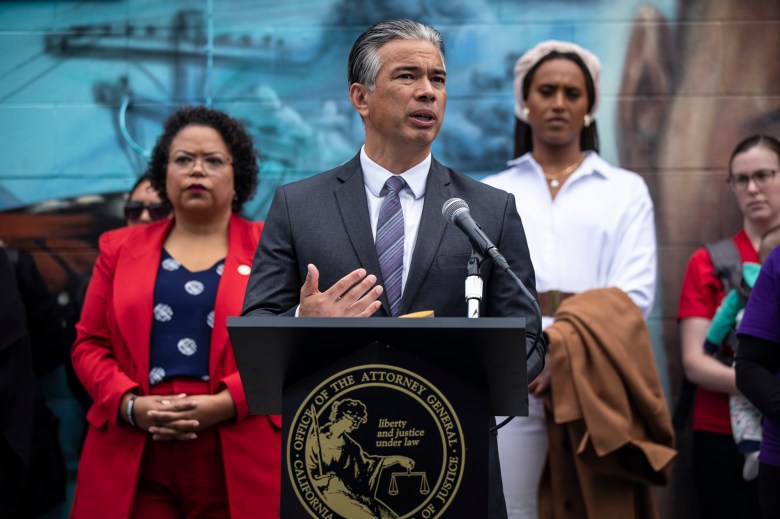
As the saying goes, you can’t manage what you can’t measure. And two very different groups — gun control advocates and Big Tech — know first-hand how essential data is for shaping policy.
On Monday, Attorney General Rob Bonta announced that the Department of Justice can continue sharing gun violence data with researchers at the Firearm Violence Research Center at UC Davis, per a recent state appeals court ruling.
The department was first authorized to provide information about gun sales under a 2021 state law. But gun rights advocates sued the department, arguing that the data violated their constitutional right to privacy.
- Bonta, in a statement: “The court’s decision is a victory in our ongoing efforts to prevent gun violence…. Research and data are vital in our efforts to prevent gun violence in California and provide a clear path to help us save lives.”
Stressing the importance of data, Bonta mentioned August and November 2023 reports about gun violence and domestic violence.
Also clamoring for more data is the Chamber of Progress, a business group backed by major tech companies including automated vehicle companies, Cruise and Waymo. In a letter to the state Public Utilities Commission and three San Francisco agencies including the police department, the organization seeks more information on collisions caused by human drivers.
Citing San Francisco’s own goal to end traffic fatalities, Chamber of Progress CEO Adam Kovacevich argues that both the city and the utilities commission are failing to publicly report the data, despite the fact that human drivers are “the sole provenance” of traffic fatalities in San Francisco. Without that information, he says, driverless vehicle safety data is “misleading.”
The letter was dated a day after Cruise’s CEO stepped down from his position. The driverless car company has been mired with controversy, as two state agencies suspended its services after a pedestrian was struck in San Francisco — first by a human-operated car and then by a Cruise car.
Speaking of data: Describing his administration’s approach as “nuanced, measured,” Gov. Newsom’s office released its first report Tuesday on generative artificial intelligence — a branch of AI that focuses on training models to create new content.
The report goes over the collective benefits and unique risks of the new technology, its potential uses for state government and its role in the California economy. It is the first in a series of steps directed by Newsom’s September executive order, which outlined the state’s approach to AI.
CalMatters Commentary
CalMatters columnist Dan Walters is away.
CalMatters commentary is now California Voices, with its first issue page focusing on homelessness. Give it a look.
Other things worth your time:
Assembly Speaker Rivas announces leadership team, committee heads // Los Angeles Times
Biden-Harris reelection campaign ramps up Hollywood fundraising // Los Angeles Times
CA Democratic Party leader Rusty Hicks files for state Assembly // Lost Coast Outpost
How tech workers in Bay Area are striving to keep Gaza online // KQED
Mass layoffs hit video game industry after its pandemic boom // Los Angeles Times
CA environmentalists sue to stop replanting of sequoia groves // San Francisco Chronicle
One year later, massive UC grad student strike leaves complicated legacy // LAist
Iger returned to Disney a year ago. It’s been a rough ride // Los Angeles Times
500+ homeless people die in San Diego County for third year // The San Diego Union-Tribune
SF to miss state housing deadline, jeopardizing local control // San Francisco Chronicle
Underpass lot below Interstate 10 failed inspection months before fire // Los Angeles Times